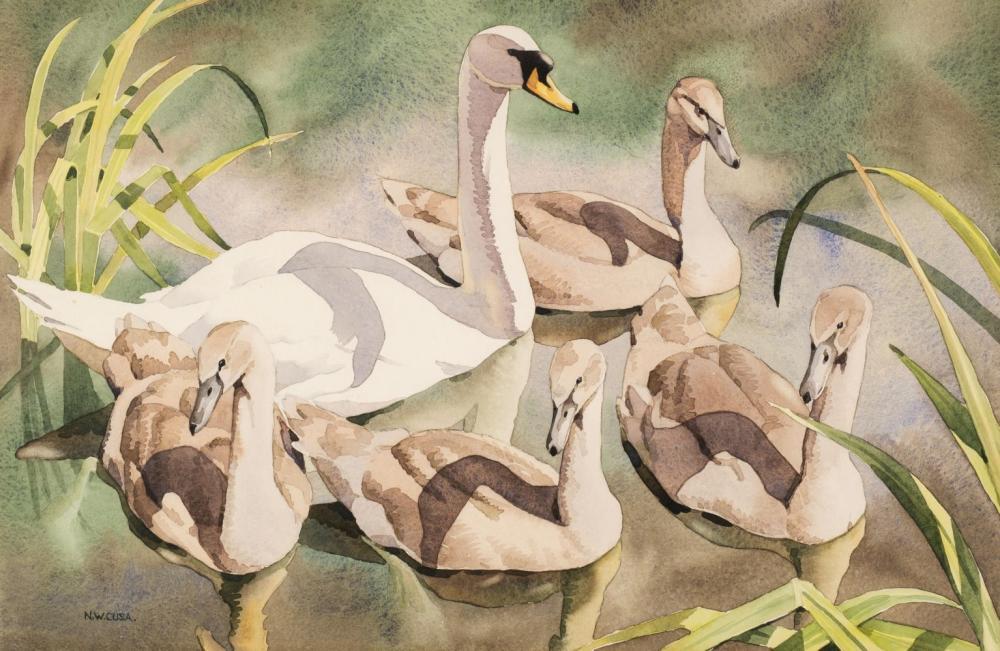
Noel Cusa 1909–1990
Noël William Cusa was educated at Magnus Grammar School in Newark-on-Trent, from where he entered University College, Nottingham to study science. His artistic training was virtually nil, save the odd advice given to him by his father who had at one time wanted to be a poster designer. As a boy he had always been interested in natural history and had been brought up on the Rev CA John’s book of ‘British Birds in Their Haunts’.
Having gained his BSc and PhD he joined ICI Pharmaceutical Division and finding himself with time on his hands at weekends he decided to revive an old childhood interest of art and birds. He bought a pair of binoculars, joined the Stockport Art Guild and in 1949 was elected to the Manchester Academy of Fine Arts. He was encouraged by criticism from his friends, especially Charles Tunnicliffe and John R Davies, a landscape painter. He attended Manchester Art School Graphic Club, the Arts Guild and the Academy when time would allow, and in 1966, at the age of 57, he retired from ICI and moved with his wife Mary to Norfolk. His desire was to continue with his art education.
His first art commission came when he was asked to submit a coloured plate and a black and white drawing for ‘The Red Book’. But it was his commission to produce eight wall charts of British birds for the RSPB that would bring his name to the bird knowing public’s attention. These were followed by the RSPB Book of British Birds by David Saunders that went on to sell over 250,000 copies.
Cusa went on to illustrate Seawatching by Tony Soper and The Lodge by the Waterfall, Flight of the Storm Petrel and Birds and Islands by the naturalist Ronald Lockley. He also illustrated the ducks for the prestigious Birds of the Western Palearctic volumes, and a series of plates for the book New Zealand Endangered Species (Cassell Publications)
Noël Cusa joined the fledgling Society of Wildlife Artists in 1965, a year after its inception. He went on to serve as Chairman and his beautiful paintings went on to grace exhibitions at Mall Galleries until his death in 1990.
He will be known primarily as a water colourist and he admired greatly the work of John Sell Cotman and of course his friend Charles Tunnicliffe. His relationship with Tunnicliffe might be considered by some as one of student and tutor – the influence is there for all to see. Indeed, after Tunnicliffe’s death Cusa would go on to write and edit two large format books on the artist, Tunnicliffe’s Birdlife and Tunnicliffe’s Measured Drawings.
It’s no surprise to learn that Cusa’s methods were similar to Tunnicliffe’s, using stuffed birds, skins and museum specimens, birds in zoos and photographs as reference. He too was more at home sketching and studying the living bird in its natural surroundings.
SWLA member Chris Sinden interviewed Cusa in 1970 as part of a series of discussions with prominent bird artists of the day. When quizzed about his approach and thoughts of painting birds Cusa responded:
“Too many people who paint birds do so virtually without training, either by their own self-criticism or more formally by their love of the beauty of birds. This leads them to an obsession with the niceties of the detail of feathers, too often superimposed on a framework lacking in any solidity of structure or relationship to natural pose or movement. They put a branch for it to stand on and a few leaves but are really quite defeated by the problem, as Tunnicliffe says, ‘of what to put around it.’ This kind of work can be technical illustration (it can satisfy the zoologist’s need for plates in text books) but it is work on a quite a different level from that of Liljefors or Tunnicliffe which can be judged aesthetically as art.”
“A good picture is a landscape with birds, maybe only a few square yards of landscape, but still a landscape. A bird artist who is not a competent landscape, portrait or still life painter is not more than a map maker of feather patterns. Many so-called bird artists are of course just that – neat tidy conscientious delineators of ornithological detail without more than a primitive ability to draw, no knowledge of perspective (linear or aerial) or little knowledge of or feeling for design or composition, be it line, shape or colour”.
Chris Sinden